Christopher Reid Flock
Basking: sketches
July 23 – August 24, 2014
“Kayo O’Young introduced me to this world of play. Mozart, as Jonathan Smith (curator at the Art Gallery of Burlington) often calls him, sits and just plays with clay. The resulting engagement questions scale, balance and form.
So, here I play with the burnt dirt, eager to grow and learn from the experience and to even make mistakes. I would be lying if I didn’t say that every single maker I have come across in the collection at the Art Gallery of Burlington or the harvest of experiences from a stint at Sheridan hasn’t had some influence. It all comes into play somehow.
It’s such a release recognizing I am not in control but often at the mercy of whatever the day throws at me; this couldn’t be realized until I moved to Japan in 2000. The full impact of this sentiment came to the forefront with that move, and I am still learning to accept this finding. This understanding brings me to the current array of pieces in which I explore the tension of control/lack of control while relying on a harvest of craft experience and the nuances of process.
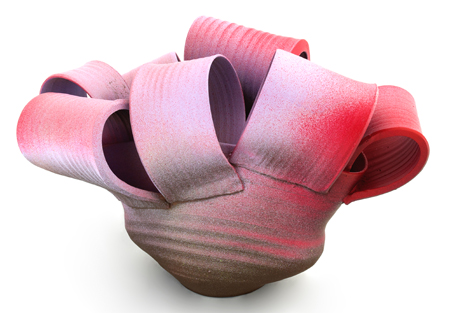
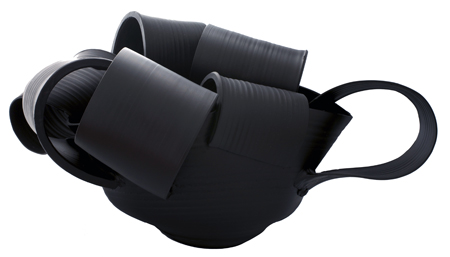
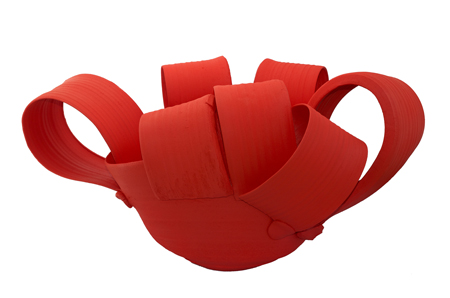
Basking, as a verb, is to bathe in some ambiance. In this case it encompasses what it means to be Canadian; we bask within and around other cultures as a collective, caring, embracing, celebrating. My basking forms simply celebrate craft’s origins and the woven history we all desperately try to grapple with. I am excited to be maker, borrower, and sharer of culture in Canada. The basket simply is an iconic form, regardless of origin, and has great value.
This brings me to the surface treatment of Basking: sketches. Through photographing my work I have allowed myself to become influenced by what digital file processing programs offer. In digital post-process manipulations with colour saturation and various filter effects such as Gaussian noise filters, the “digital sketching” is beginning to play numerous roles that in turn influence what pattern or colour scheme develops on the piece. I find bringing a finished piece to fruition through sketching and manipulating a digital surface, fascinating.
Further to this, the immediacy at which digital imaging can be processed becomes instantly historical while continually illustrating contemporary significance. What a dichotomy! Therefore Latex paint has become my answer to this fascinating link between digital photo file manipulation and ceramic surfaces. As a form of surface treatment, employing paint calls to question what is surface and ultimately the purpose of the vessel.
A glazed piece vitrified in a kiln, has without question many historical links and values. Of course, there are those, and I am of course one of them, who love the look of a multiple day firing in a wood kiln, or the lure of what any fossil fuel burning kiln can produce with any number of brilliant glazes… Taking the air-dried approach to surface treatment for this series additionally is fun, painterly, and above all curious. It also links my feeling towards the notion of what a finished piece is, be it from a camera or a wheel.
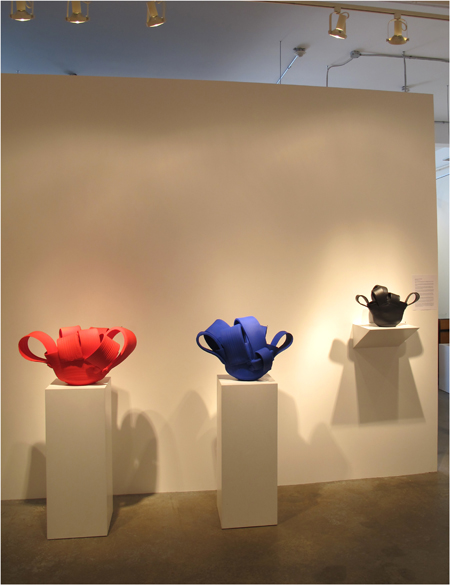
Drawing towards the arrangements, I again play with not only my personal history with honing my skills from bowl to more complex forms, but my understanding of the Japanese aesthetic of beauty. As arrangements, the notion of employing garden hose in the Kosetsu style of Ikebana simultaneously plays homage to the art of bonsai. The miniature has become the giant in this free form arrangement of garden hose/grass arrangement. The arranged bowls play with the idea of children’s paint pucks but also resemble a micro abstraction of the very pixels that influenced my surfaces and colours. The interplay of scale, culture, and interpretation of content continues to motivate me to explore.” Christopher Reid Flock