Christina Luck
My Town: painting
June 2 – 26, 2011
The paintings in this exhibition My Town present a possible theatrical version of my neighbourhood. The tongue-in-cheek use of stock characters is intended to mock the standard urban view of village life, that as a transplanted urbanite I have often improperly held to be true. My real town is lucky enough to have a thriving community theatre in a 19th century Temperance Hall where I am the default set designer. I approached My Town as I might a play (and an obvious play on Thorton Wilder’s Our Town), although there is no play here, just a stage, actors and props.
There are 4 categories of painting: the houses, headshots, stage trees and tableaux.
The houses, complete with notes on previous real town and current My Town occupants as well as interesting bits of local lore, reveal through their architectural styles a typical Ontario town.
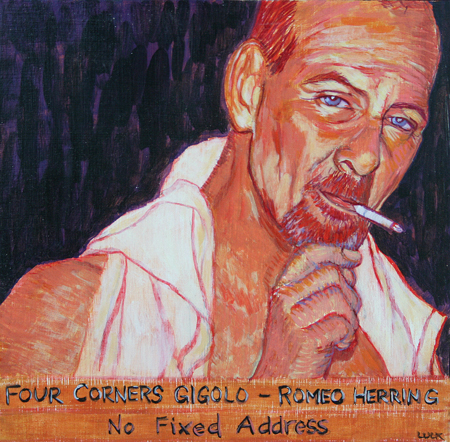
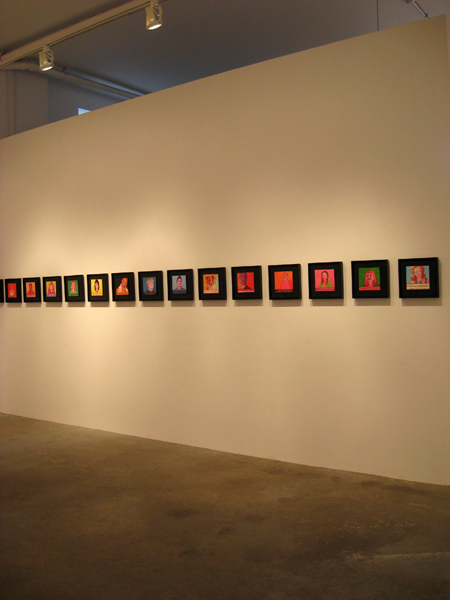
The headshots are portraits of some of my neighbours, to whom I have given character names and roles to play, which are not meant to reflect in any way their true natures. I painted from photographs I took because I like the transformations exacted by the camera itself and by the act of posing for the camera. The headshots refer to actors photographs used for auditions and publicity, as well as drivers licence photos or in some cases, police mugshots. It is important to note that dogs are extremely important members of the community.
Stage trees form the proscenium, arching over the acting area and sometimes masking the wings. I love the trees in my real town. Planted generations ago they feed and shelter our giant squirrels and cool our decks and houses in summer. The four paintings are of my favourites, in and out of the spotlight.
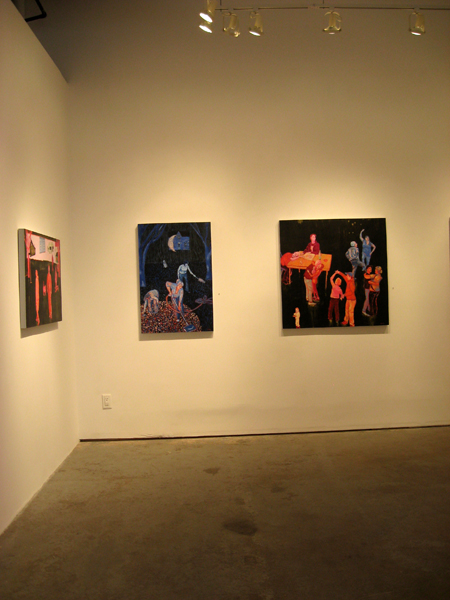
The tableaux reference 17th century genre paintings like those of Steen and Brueghel, as well as Degas’ paintings of back stage at the ballet. The Cleaners is an obvious nod to Millet’s The Gleaners. First I set up the space in my imaginary box of a theatre, using a rising perspective as I usually do in concept drawings for the stage. I have given my imaginary theatre something my real one does not: a fly gallery so houses can be lowered in and out of a scene. Again, I asked my neighbours to pose for me, but as individuals so their place in the scene and relationships to each other are determined in the studio. Therefore there is some illogic to the scale and perspective. This is my painterly analogy for the effect of lighting on stage, as space seems to shift and change as it is carved out by light and the walls we use to judge depth disappear in black shadows.


01luck